CLAIRE
O'SULLIVAN



F0rensics for Writers
1. Fingerprinting & Kits
2. Trace Evidence
3. Facial Recognition
4. Photography
5. Blood Spatter
6. The Autopsy
Free classes for Writers
1. Active Shooter Response
2. Common Weapons
3. Hand to Hand
4. SWAT mission debrief
5. Basic Crime Scene investigation
6. Death Investigator
7. Evidence Management
8. Decision making
9. Duty Gear over the years


FINGERPRINTS - OLD AND NEW
Yes, dear, I had a great day at work. Can you rub my neck?

Fingerprinting has been around since ... Babylonia (what is now Iraq), but used primarily for business transactions - set in clay. COOL. But not used in forensics until the 19th century - several countries found fingerprints around the same time. But blurry-eyed detectives painfully (in the most literal way) examined each print. Remember: there are 10 prints per sheet. A job I wouldn't appreciate, though through forensic classes, we did have to learn how to print suspects.
For those interested in the deets, printing includes an ink pad, a card for 10 prints, and a suspect to print (seems so obvious.

A typical fingerprint card. Take note: more boxes, more information on each print. I have done this. I've also printed my kitchen one night at midnight.


Now - more police departments with decent budgets are moving toward scanners. Faster, easier, the perp/suspect can be processed faster and more suspects run through. You may find yourself printed if you are obtaining a CCW or in various occupations.
Trace Evidence
MVAC - forensic vacuum for trace evidence


Facial Recognition

This can be great. It also can be wrong.
Facial Recognition depends on a lot of factors. It's not always accurate.
Makes for great plot twists and courtroom drama.
Crime Scene Photography
Photography is complex in forensics. Here is a basic kit from Crime Scene Investigator Network
Thanks to Steven Staggs for this article: Crime Scene Photography Kit
-
Camera
Most crime scene photographers use a high quality digital camera or 35mm camera. Digital cameras which have twenty megapixel, or greater, image sensors and manual exposure settings (in addition to any automatic or programmed exposure modes) are usually suitable for crime scene and evidence photography. -
Normal lens
A normal lens provides the best perspective for most photographs. A 50mm lens is considered a normal lens for a 35mm camera. -
Wide–angle lens
A wide-angle lens is needed when photographing small rooms or other space–constricted areas. A 28mm lens is considered a wide–angle lens for a 35mm camera. -
Close–up lens or close–up accessories
Most normal lenses do not focus closer than about three feet. A macro lens or a close–up accessory for the normal lens is needed to photograph small items of evidence. Close–up accessories include 1:1 adapters, extension tubes, bellows, reversing rings, or close–up filters. -
Filters
A polarizing filter is often needed for photographing through glass and into water. Colored filters (red, orange, yellow, blue, and green) are useful when photographing certain types of evidence with black–and–white film. -
Electronic flash
Electronic flash provides additional light that is often needed when photographing indoors, outdoors at night, filling in shadows in bright daylight scenes and for lighting evidence. -
Remote sync cord for electronic flash
A remote sync cord allows the electronic flash to be operated when it is not mounted on camera. Many photographs, especially photographs of certain types of evidence, cannot be photographed with the flash mounted on the camera. -
Extra camera and electronic flash batteries
Batteries can expire without warning during the documentation of a scene. Extra batteries for both the camera and electronic flash should be included in the camera kit. -
Locking cable release
A locking cable release is used to lock open the camera's shutter during long exposures and when using the “painting with light” technique for photographing large nighttime scenes. Cameras that have a built-in feature that locks open the shutter do not require a locking cable release. -
Tripod
Tripods are necessary to steady the camera for long exposures and for positioning the camera during certain types of evidence photography. -
Film
Medium speed (ISO 100 or 200) color print film is most often used for crime scene photography. Black–and–white film is used for certain types of evidence photography. -
Operation manuals for camera, electronic flash and accessories
Equipment operating manuals should be carried in the field for reference. With the many features on modern cameras and electronic flash units, it may be necessary to refer to the manuals for specialized photographic techniques -
Photo log, notebook and pen
A photo log is necessary for recording information about each photograph taken at a crime scene. A notebook is valuable for recording other notes during the investigation. -
Scales and tape measure
A variety of scales, including 6 inch and 36 inch sizes, must be available for photographing different types of subjects. Long tape measures with large numbers are sometimes necessary when photographing large items of evidence or large areas in a crime scene. -
ABFO #2 scale
The ABFO #2 scale is the preferred scale for photographing injuries. -
Angle–finder
An angle finder is used to help position a camera for photographing certain types of evidence at the crime scene. -
Color chart or color control patches
Color chart or color control patches are useful as color references in injury photography -
18% gray card
The 18% gray card is used as an aid in getting accurate exposures. -
Index cards and felt pen
When a number or other identifier is need in a photograph, simply write the number or identifier on an index card and place it in the photograph. -
Flashlight
A flashlight not only helps you see in dark areas, but it is useful for previewing lighting during evidence photography. By shining the light on evidence from different angles you can see where it is best to position the electronic flash for a photograph. -
AND consider:
-
Telephoto lenses
While telephoto lenses are seldom used in crime scene photography, they are necessary for most types of surveillance photography. -
-
Supplementary light meter
Supplementary light meters are usually more effective than the metering system inside the camera and are most useful for low light level readings, such as ambient light photography at night. -
-
Small tools
Small tools are helpful when emergency camera repairs must be done in the field. -
-
Devices for positioning evidence and scales
Blocks of wood, clothespins, clamps and other devices can be used for positioning evidence and scales for close-up photography. -
-
White handkerchief or other flash diffusion material
A white handkerchief or similar material can be placed over the head of an electronic flash unit to reduce the intensity of the flash.
Blood Spatter Patterns to Know When Writing Forensics
Measurements of -


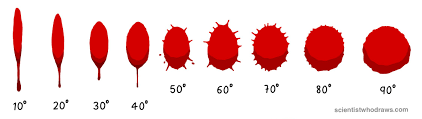
Velocity and Direction

The Forensic Autopsy

If you ever see an autopsy report printed this legible in real life, let me know.
A 30-minute discussion with pathologist, Dr. Nicole Jackson


Very entertaining, no blood, live 'client, autopsy.'
One of my favorite books


